
Tech Stack
On 15 September 2026, a San Francisco startup called TypeSafe AI announced Jev. Within a week it was the most talked-about model on the internet, sold as a cheaper, faster alternative to the large language models everyone already uses.
That framing is the first thing to correct, because TypeSafe's own documentation corrects it: "Jev isn't a drop-in replacement for an LLM. It doesn't generate text."
Jev does not chat, summarise, write code or explain itself. It reads a situation and answers a question about it with a typed value and a probability. That sounds like a limitation. For a surprising amount of real software, it is exactly the thing you wanted and were paying an LLM to fake.

What Jev is, in one sentence
It reads input like a language model and answers like a classifier.
You give it a state — the context: a customer message, a JSON record, an agent's conversation so far — and one or more questions about that state. It returns a structured answer to each, with a probability attached. No prose, ever.
The three kinds of question it answers
| Type | What you ask | What comes back |
|---|---|---|
| Choice | Pick one of these options | A probability for every option, plus confidence |
| Score | Rate this on an ordered scale | A continuous score and the full distribution |
| Yes / no | Is this statement true? | The probability that it is |
One detail matters more than it looks. Per TypeSafe, adding more questions to the same state "barely changes the response time" and costs only the extra question tokens. So the natural pattern is not one call per decision — it is one call per situation, asking everything you need to know about it at once.
Why it's called a "System One" model
The name comes from Daniel Kahneman's split between System 1 — fast, intuitive judgement — and System 2, slow deliberate reasoning. TypeSafe's bet is that LLMs are being used as System 2 engines for work that is really System 1: is this spam, which team owns this ticket, is this tool call safe, is this lead worth a callback.
Those are judgements, not essays. Paying a model to write a paragraph and then parsing a label out of it is slow, expensive, and occasionally returns a label that is not in your list at all.
The actual numbers
All of these are from TypeSafe's own launch post and documentation.
| Model | jev-1.13.0 (aliases: jev-latest, jev-preview) |
| Status | Early access, waitlist |
| Input price | $0.042 per 1M tokens ($42 per billion) |
| Output price | Free — "too cheap to meter" |
| Latency | 70-500 ms end to end |
| Context | 64k tokens per request: 32k for the state plus the longest question |
| Rate limits | 250,000 tokens/sec, 1,200 requests/min — "adjusting dynamically" |
| Input | Text only: strings, JSON, arrays. No images, audio or video |
| Languages | English best; others supported at lower accuracy |
Where the hype runs ahead of the product
Jev is genuinely interesting. The way it is being described online is not quite what the company itself claims. Five places to be careful:
1. "No hallucinations" is about format, not truth. Jev cannot return a label that is not in your list or a malformed answer — the output is constrained by construction. That is real and valuable. But it can still pick the wrong label. TypeSafe's own docs say it plainly: calibration "does not guarantee that an individual answer is correct."
2. "193x faster, 444x cheaper" is the top of their own range. The headline figures — 193.6x faster and 444.6x cheaper — are described by TypeSafe itself as the "higher end of real world gains." The broader speed claim in their launch post is 40x to 200x. Plan with the conservative end.
3. There is no standard benchmark table — on purpose. TypeSafe has publicly rejected leaderboard-style results and says it will publish evolving internal evals as dated snapshots instead, including results that look bad for them. That is a defensible philosophy. It also means that, today, nobody can independently compare Jev against the model you already use. You will have to measure it yourself.
4. It is a component, not a platform. Jev does not replace your LLM; it sits beside it. Anything that needs words — the reply to the customer, the generated code, the summary — still needs a language model.
5. It is early access. Rate limits are moving under high demand, and a waitlist stands between you and production.
Where it actually earns its place
This is the part worth your time. If you build software, these are the jobs where a fast, cheap, probability-carrying decision beats a slow model writing text:
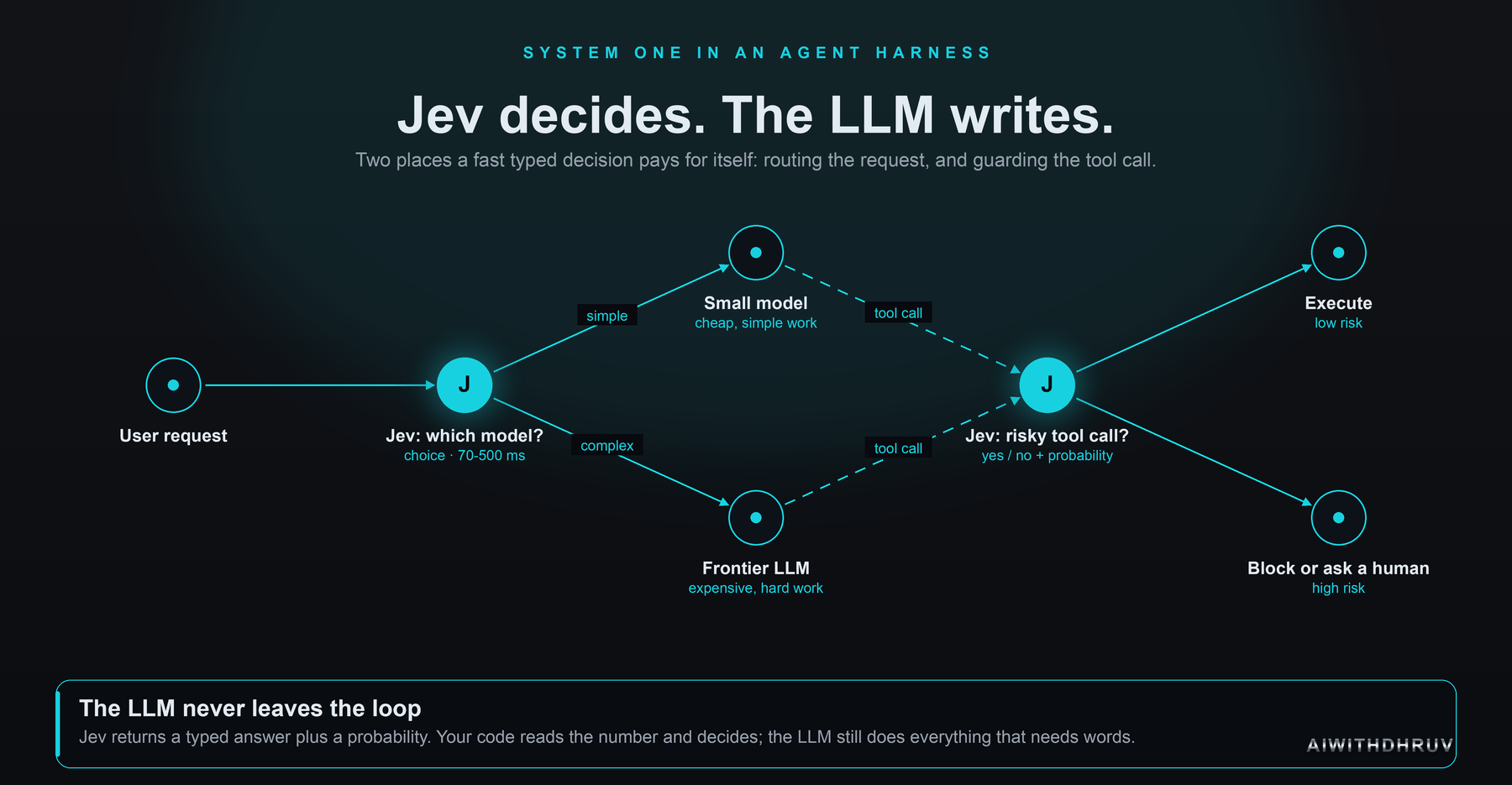
- -Routing. Decide which model handles a request — a small cheap one for simple lookups, a frontier model for hard reasoning. Most agent bills are dominated by sending easy work to expensive models.
- -Guardrails on agent actions. Before a tool call executes, ask: is this risky? Block it or escalate to a human when the probability is high. This is TypeSafe's own headline use case.
- -Ticket and message triage. Which queue, what priority, is this a complaint. Every support desk in the world runs this decision thousands of times a day.
- -Lead and intent scoring. Is this enquiry worth a callback today.
- -Re-ranking in RAG. Score retrieved chunks for relevance before the LLM reads them. TypeSafe publishes a cookbook for exactly this.
- -Grading and evals. Judge agent outputs at a price where you can afford to grade all of them, not a sample.
What the price means in practice
A worked example, so the numbers become real. This is my arithmetic at published list prices, not a TypeSafe figure.
Say you triage one million WhatsApp messages a month. Each message plus your questions is about 250 input tokens. That is 250 million input tokens.
| Input cost for the month | |
|---|---|
| Jev at $0.042 per 1M | about $10.50 |
| A frontier LLM at $10 per 1M input | about $2,500 — before output tokens |
The gap is two orders of magnitude, which matches TypeSafe's claim. But the price is not the decision. Accuracy on your data is the decision, and a triage model that is wrong one time in five costs you far more than $2,500 in unhappy customers.
How to test it on your own data, properly
Do not trust a launch video, and do not trust this post either. Run this:
- 1.Pull 200 real, labelled examples from your own logs — actual messages, actual correct answers.
- 2.Run both Jev and your current model on the same 200.
- 3.Compare accuracy — the obvious part.
- 4.Check calibration — the part people skip. Group the answers by Jev's confidence. When it says 90%, is it right about 90% of the time? If yes, the probability is usable.
- 5.Set an escalation threshold. Anything below, say, 80% confidence goes to your LLM or a human. Now you have a system that is cheap on the easy majority and careful on the hard minority.
That fifth step is where the real value is. A model that knows when it does not know is worth more than a model that is slightly more accurate and always sure of itself.
I already run a gate like this on a WhatsApp agent I work on: requests the intent check cannot place confidently are rejected before the expensive model ever sees them, and the count of those rejections is one of the most useful live signals the system produces. Jev is that pattern, packaged as a product.
What this means for teams in India
Two things, one encouraging and one cautionary.
The encouraging one: Indian software lives and dies on unit economics. A support desk, a sales team or a WhatsApp business handling lakhs of messages cannot afford frontier-model pricing on every message. Near-free classification changes which automations pencil out at all.
The cautionary one: TypeSafe says English is Jev's strongest language and other languages run at lower accuracy. Real Indian traffic is Hindi, Hinglish, regional languages and English mixed inside one sentence. If that is your data, the 200-example test above is not optional — it is the entire decision.
The honest limits of this piece
Jev is in early access and I have not run it on production traffic, so everything here is from TypeSafe's own launch post and documentation, read carefully. Wherever a figure appears in this post, it is theirs, except the worked cost example, which is clearly marked as my arithmetic.
Several numbers are circulating online — funding amounts, valuations, view counts — that do not appear on TypeSafe's own site. I have left them out. None of them tell you whether the model is right for your system anyway.
The question I cannot answer
If a decision costs almost nothing, the obvious move is to put a Jev-style checker in front of every agent action. Then every agent has a second model watching it.
But the watcher is only as good as its calibration, and calibration is measured across many predictions — it says nothing about the one that matters. So when the watcher is 97% sure a tool call is safe, and it is wrong, who notices?
I do not have an answer yet. I suspect whoever builds a good one will matter more than the model itself.
Want to build something like this?
I architect and deploy end-to-end AI systems — from MVP to revenue.
Let's TalkOr ask Angelina — my AI twin in the bottom-right corner. She knows my full build history, live GitHub, and how I'd approach your project.